SERVICES · STAGE 03 OF 04
All servicesA site a stranger can act on.
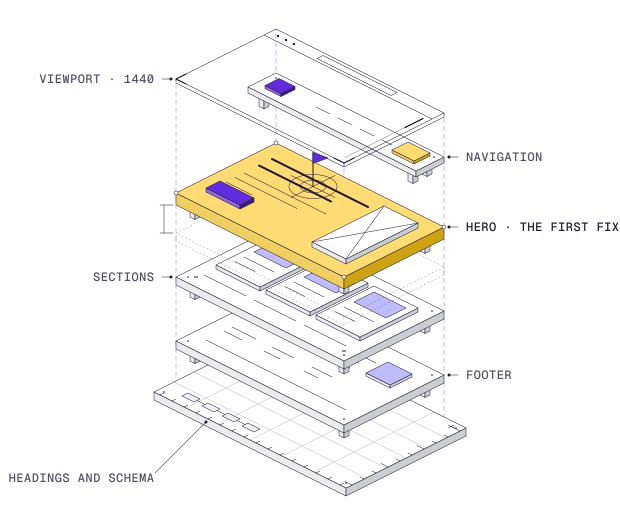
Web design is the third of APP/ART's four stages. It is the marketing site: the sitemap, the path to an enquiry, the design system and every page, each built around one thing you need a visitor to do.
- INCLUDED IN
- Both options
- ORDER
- Third of four
- LED BY
- Guille Barcia
- YOU RECEIVE
- 24 to 30 pages, or up to 14


What you get.
EIGHT THINGS, ONE SITE- 01
Information architecture
The sitemap, built from how your buyers decide. Every page has a purpose and the pages are counted. The count is what the quote names.
- 02
Conversion architecture
For each kind of page: one committed action, one uncommitted, and the proof placed where the objection occurs.
- 03
Design system
Buttons, cards, navigation, page skeletons. Pages are assembled from components, so a new page matches the old ones.
- 04
Marketing site
Every page in the sitemap at full fidelity, with the real copy and the real illustration, at every screen width.
- 05
Landing pages
Pages for one campaign, one tender or one audience, built from the same system.
- 06
UX and prototyping
A working prototype of the navigation and the key interactions, shown before the build.
- 07
Framer or custom build
Built in Framer or as custom code, on a design system your own team can run.
- 08
Accessibility pass
Contrast where each colour is used, focus states, touch targets, reading order and alt text.
How we do it.
FOUR STEPS, FOUR CHECKS, ONE STANDARD- 01 OF 04
The map.
The sitemap comes from your buyers' paths, not from a competitor's menu. Every page gets a purpose.
DONE WHENThe navigation and the sitemap agree, page for page.
- 02 OF 04
The path.
Each kind of page gets one committed action and one uncommitted one. The contact path is a real page, not an email link.
DONE WHENEvery page has a next action and a reason someone would take it.
- 03 OF 04
The system.
Components first, pages second.
DONE WHENA page can be built from instances only, with no one-off copies.
- 04 OF 04
The pages.
The home page first, to set the pattern. Then the interior pages, with the same care.
DONE WHENEvery screen width is drawn, not assumed.
Every page is looked at before it ships.
No overlaps, no cut-off text, no placeholder content.
On a real company.
SEQANA · A PROPOSAL, NOT A COMMISSIONTwenty-three pages. One way in.
Home and 23 pages, in five groups. Eight pages designed at 1440 wide, sixteen specified, and the eight wired into a working prototype.
Two decisions carry the site: one fork under the hero, and one first step at the end of every page.
SEQANA DID NOT ASK FOR THIS WORK AND HAS NOT REVIEWED OR APPROVED IT
Read the Seqana caseCONVERSION ARCHITECTURE · THREE DECISIONS
Agrifood companies and project developers part ways under the hero.
Each path keeps its own vocabulary, proof and pace.
Every page ends on the same first step.
A feasibility assessment: fixed price, two to three weeks, a decision at the end.
Three calculators, free, no email required.
Competence is proven before contact.
funded deep tech sites had a working email for a named person.
OUR AUDIT, SEPTEMBER 2026 · 45 SITESLIMIT · SIX SITES COULD NOT BE CONFIRMED. UNKNOWN, NOT FAILURES.What founders ask about the site.
NOT ANSWERED HERE?
tony@appart.giSend your site. We name the first fix.
One line about where you are going is enough. The reply comes back in writing. No call needed.
Or book a 30 minute call