SERVICES · STAGE 01 OF 04
All servicesWe read your papers. Then write your claim.
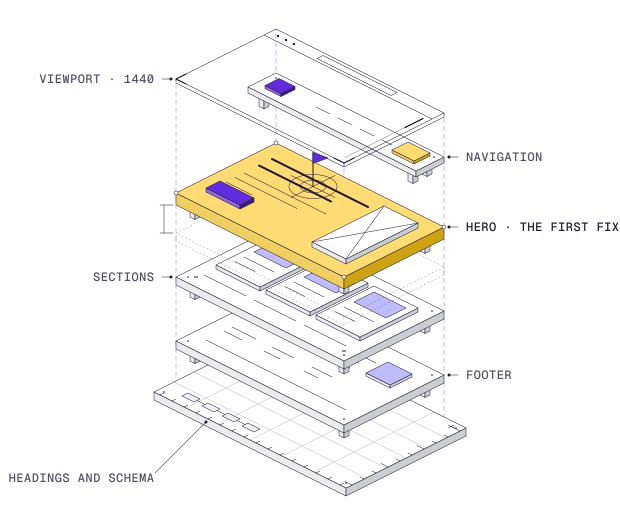
Brand foundation is the first of APP/ART's four stages. It settles what a deep tech company claims, who the claim is for and the words it is made in, before anything is drawn.
- INCLUDED IN
- Both options
- ORDER
- First of four
- LED BY
- Tony Bocoya
- YOU RECEIVE
- Nine things, in writing


What you get.
NINE THINGS, IN WRITING- 01
Brand archaeology
What the company already says about itself: every page of the site, the funding announcements, the founders' papers, talks and posts, and where the name came from.
- 02
Market intelligence
Who is funding the sector, what changed in the last eighteen months, and why a buyer would act in the next six, in one paragraph.
- 03
Competitor audit
Six to twelve competitors read on their live sites: what each one says, how it proves it, and which colour it owns.
- 04
Audience profiles
Two to four buyers. For each: what they are measured on, the objection they raise and the evidence that answers it. Then who signs and who blocks.
- 05
Positioning
One line, the three claims that support it and the evidence for each. Also in writing: what the company gives up by choosing it.
- 06
Naming
A name for a product, a method or the company, where one is missing.
- 07
Messaging architecture
The one line, the three supporting claims, and the sentence each kind of page carries.
- 08
Tone of voice
Register, tempo, vocabulary, and the words the company never uses.
- 09
Investor narrative
The same claim written for a fund: the problem, the proof and why now.
How we do it.
FOUR STEPS, FOUR CHECKS, ONE STANDARD- 01 OF 04
Listen.
We read everything the company has published before we judge any of it.
DONE WHENWe can write one paragraph in your voice that you would recognise as your own.
- 02 OF 04
Map.
Market, competitors and audience, side by side.
DONE WHENWe can name one thing every competitor says and one thing none of them says.
- 03 OF 04
Choose.
We write ten candidate positions and test each one. Is it true? Can you own it? Would a competitor find it hard to copy? Do the founders recognise it?
DONE WHENOne position survives, with what it gives up written down.
- 04 OF 04
Write.
Headlines first, because they are the hard part. Then the copy for every page in the sitemap.
DONE WHENNo headline still works with a competitor's name in it.
A physicist on your team could read the finished site aloud without stopping to correct it.
Nothing is finished until then.
On a real company.
SEQANA · A PROPOSAL, NOT A COMMISSIONWe took the founders' own words as the brief.
In June 2026 Seqana raised €3.2M, and its chief executive wrote that the company is "the measurement layer". The site still described the soil carbon vendor it had been refreshed for eleven months earlier.
The position had already been written, across three of the company's own posts. One decision shaped everything after it: the instrument, not the farm.
SEQANA DID NOT ASK FOR THIS WORK AND HAS NOT REVIEWED OR APPROVED IT
Read the Seqana caseTHEIR OWN WORDS · THREE DATED STATEMENTS, READ LIVE
"Complexity is not a bad thing; a lack of clarity is."
The post announcing Seqana's brand refresh, signed by its three founders.
"Verra's VM0042.v3, co-authored by Seqana, is open for public consultation."
The title of a post by a co-founder and two colleagues.
"We are the measurement layer."
The chief executive, on the day Seqana announced a €3.2M round.
out of 7 for the author of the plain version, rated for intelligence. The original scored 4.26.
OPPENHEIMER, 2006 · 85 STUDENTSLIMIT · A MODEST EFFECTWhat founders ask about the claim.
NOT ANSWERED HERE?
tony@appart.giSend your site. We name the first fix.
One line about where you are going is enough. The reply comes back in writing. No call needed.
Or book a 30 minute call