RESEARCH
All researchThe four layers.
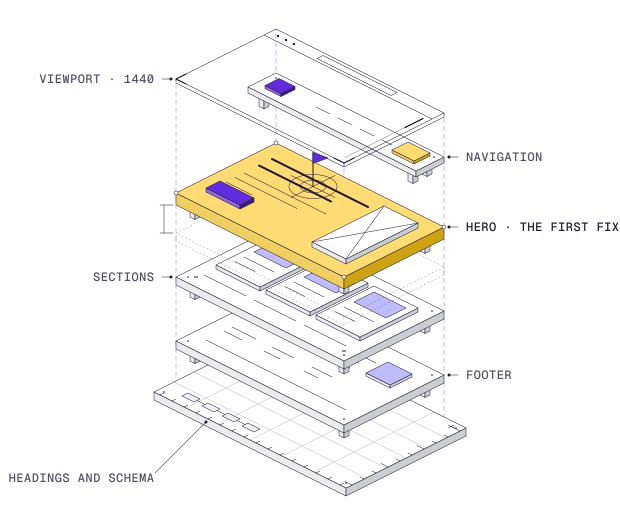
A logo is one piece. A brand is four layers saying the same thing, built from the inside out and met from the outside in.


of the comments people wrote about a website's credibility mentioned how it looked, more often than any other feature.
STANFORD PERSUASIVE TECHNOLOGY LAB AND CONSUMER WEBWATCH, 2002 · 2,684 PEOPLELIMIT · PUBLIC WEBSITES IN TEN CONSUMER CATEGORIES IN 2002, NOT BUSINESS BUYING. IT COUNTS WHAT PEOPLE WROTE, NOT WHAT THEY DID NEXT.The question.
What is a brand made of, and in what order should it be built? We organise the work into four layers: strategy, verbal, visual and touchpoints. They are built from the inside out, and a buyer meets them from the outside in. For a company whose product is ahead of how it looks, that reversal is where trust is won or lost.
How we know.
The four layers are APP/ART's own way of organising brand work, not a research finding. The evidence for the order comes from outside. In 2002 the Stanford Persuasive Technology Lab and Consumer WebWatch had 2,684 people each compare two live websites, pick the more credible one and say why, and a companion study put 15 health and finance experts in front of 20 of the same sites. In 2012 Tuch and colleagues at the University of Basel showed website screenshots to 82 people for 17, 33 or 50 milliseconds and asked them to rate each from ugly to beautiful. In 2025 Gartner published a survey of 632 B2B buyers, run in August and September 2024. The size of a buying group comes from an analyst quoted in that release, not from the survey.
What it means.
A buying group of five to 16 people from up to four functions is likely to include people who cannot judge your technology. They judge what they can reach: the page, the deck, the proposal. If those were made before anyone settled what the company stands for, each one says something slightly different. Building the layers in order is how you stop that, though it is not proof of a revenue effect and we do not claim one.
What each group leaned on most.
THE REASON EACH GROUP MENTIONED MOST IN ITS CREDIBILITY COMMENTSSTANFORD AND CONSUMER WEBWATCH, 2002. STRANGERS READ THE OUTSIDE, EXPERTS READ THE INSIDE. THE EXPERT ROWS REST ON EIGHT AND SEVEN PEOPLE, SO READ THEM AS DIRECTION.
Three reasons the order matters.
WHAT OUTSIDE RESEARCH SAYS ABOUT HOW A STRANGER MEETS YOUThe outermost layer was the one people mentioned most when they explained what they believed.
A judgement of the look forms almost at once. It was a lab test with flashed screenshots, not real browsing.
Each of them meets you somewhere, so every piece has to tell them the same story.
In depth.
THE LONG READWhat are the four layers of a brand?
The four layers are APP/ART's own model for organising brand work. They are not a research finding. Layer one is strategy: what you stand for, meaning who it is for, what you do best and what you will not do. Layer two is verbal: how you sound, meaning the name, the one sentence, the tone and the key words people repeat. Layer three is visual: how you look, meaning logo, colour, type, images and layout. Layer four is touchpoints: where people meet you, meaning the website, the deck, the company profile, proposals, emails and events. The logo is one of five pieces in one of four layers. A logo is one piece. A brand is every piece saying the same thing. Cover a friend's face and you would still know them by their voice and by how they act. The face is the logo. The person is the brand.
Built inside out, met outside in.
The layers are built from the inside out. Strategy comes first because it decides what the words say. The words come before the look because the look should say the same thing as the words. Touchpoints come last because each one is the other three applied to a page, a slide or an email. A stranger meets the layers in the opposite order: a touchpoint first, then how it looks, then what it says, and last what the company stands for. What we see in technical companies is the build order reversed: the product, then a website, then words, and strategy last if at all. That is our observation from the work, not a count. When it happens, the layer a stranger meets first is the one with the least thinking behind it. Decide the inside first, so the outside has one thing to say.
What does the research say about the outside?
In 2002 the Stanford Persuasive Technology Lab and Consumer WebWatch asked 2,684 people to each compare two live websites from one of ten categories, pick the more credible and say why. Of the 2,440 comments they wrote, 46.1 percent mentioned how the site looked. Nothing else was mentioned as often. A companion study with Sliced Bread Design put eight health experts and seven finance experts in front of the same health and finance sites. Consumers mentioned the look in 54.6 percent of comments on finance sites and 41.8 percent on health sites. The experts mentioned it in 16.4 percent and 7.6 percent. Health experts relied most on name and reputation, in 43.9 percent of their comments, and finance experts on the scope of the information, in 40.3 percent. A founder is the expert on their own company. On this evidence, the expert is the person least likely to notice what everyone else is judging.
How fast is the judgement, and how many people make it?
In 2012 Alexandre Tuch and colleagues at the University of Basel flashed screenshots of company websites and asked people to rate each from ugly to beautiful. In the second study, 82 people saw 80 pages for 17, 33 or 50 milliseconds. Even at 17 milliseconds, how complex a page was and how typical it looked for its kind already changed the ratings. The buyer is also more than one person. Gartner surveyed 632 B2B buyers in August and September 2024. In the May 2025 release of that survey, a Gartner analyst describes buying groups of five to 16 people across as many as four functions. There, 74 percent of buyer teams showed what Gartner calls unhealthy conflict, and groups that reached consensus were 2.5 times more likely to say their deal was high quality. They all have to agree on you, and each of them meets you somewhere.
What does this not show?
None of this proves that a brand raises revenue, and we do not claim it does. The Stanford study is from 2002, covered public websites such as health, finance and news sites, and counted what people wrote, not what they did next. Its expert panel was 15 people. The Tuch study flashed screenshots in a university lab, only 30 people saw the 17 millisecond exposure, and its authors say the findings cannot be tied directly to how websites are perceived in real life. The Gartner figures come from a press release, and consensus going with deal quality is a link, not a cause. No study here tested the four layers or the order we build them in. What the research supports is narrower: strangers judge the surface, quickly, and several of them decide a business purchase.
What should a company selling complex technology do?
Start at layer one and write the sentence: who it is for, what you do best, what you will not do. Then check the outside against it. A made-up battery company's website says innovative solutions, its deck says the future of energy, its profile says next-gen cell technology and its emails say powering tomorrow. The logo matches on all four. The story does not. After the work, all four say twice the battery life. Then make the outermost layer answer a stranger. In our own audit of 45 funded deep tech websites in September 2026, we found exactly one working direct email for a named person. Six contact routes could not be confirmed, so they are unknown, not failures. The right sentence with nobody to write to is still unfinished.
What to do with it.
THREE THINGS TO CHECK ON YOUR OWN COMPANYCover your logo.
Would people still know it is you? If not, the logo is doing a job that belongs to all four layers.
Ask for the sentence.
Could your whole team describe you in the same sentence? Ask three people separately and compare what comes back.
Read every piece side by side.
Do your website, your deck and your proposals tell the same story? Each person in a buying group of five to 16 meets you somewhere different.
ONE QUESTION
Do your website, your deck and your last proposal say the same sentence about what you do?
Yes or no. If it is no, the fix starts at the strategy, not at the logo.
Asked about this research.
NOT ANSWERED HERE?
tony@appart.giEVERY FIGURE HAS A SOURCE
Sources and limits.
- OUR MODELThe four layers are APP/ART's own way of organising brand work: strategy, verbal, visual, touchpoints. They are not a research finding.
- FOGG AND COLLEAGUES, 2002Fogg, Soohoo, Danielson, Marable, Stanford and Tauber, 2002. How Do People Evaluate a Web Site's Credibility? Results from a Large Study. Stanford Persuasive Technology Lab and Consumer WebWatch. 2,684 people, 2,440 comments, 100 sites in ten categories.
- STANFORD AND COLLEAGUES, 2002Stanford, Tauber, Fogg and Marable, 2002. Experts vs. Online Consumers: A Comparative Credibility Study of Health and Finance Web Sites. Sliced Bread Design, Stanford Persuasive Technology Lab and Consumer WebWatch. Eight health experts and seven finance experts.
- TUCH AND COLLEAGUES, 2012Tuch, Presslaber, Stöcklin, Opwis and Bargas-Avila, 2012. The role of visual complexity and prototypicality regarding first impression of websites: Working towards understanding aesthetic judgments. International Journal of Human-Computer Studies, volume 70, issue 11, pages 794 to 811. Study 2: 82 people, 80 pages.
- GARTNER, 2025Gartner, press release, 7 May 2025. Gartner Sales Survey Finds 74% of B2B Buyer Teams Demonstrate Unhealthy Conflict During The Decision Process. 632 B2B buyers, surveyed August to September 2024. The five to 16 figure is an analyst's statement in the release.
- OUR AUDIT, 2026APP/ART audit of funded deep tech company websites, September 2026. 52 sites read, 45 kept with the full audit.
- LIMITSThe model is ours and untested by any study. The Stanford work is from 2002, on consumer categories, with 15 experts. The Tuch study is a lab test with flashed screenshots, and 30 people saw the 17 millisecond exposure. The Gartner figures come from a press release. In our audit, six contact routes could not be confirmed.


Send your site. We name the first fix.
One line about where you are going is enough. The reply comes back in writing. No call needed.
Or book a 30 minute call